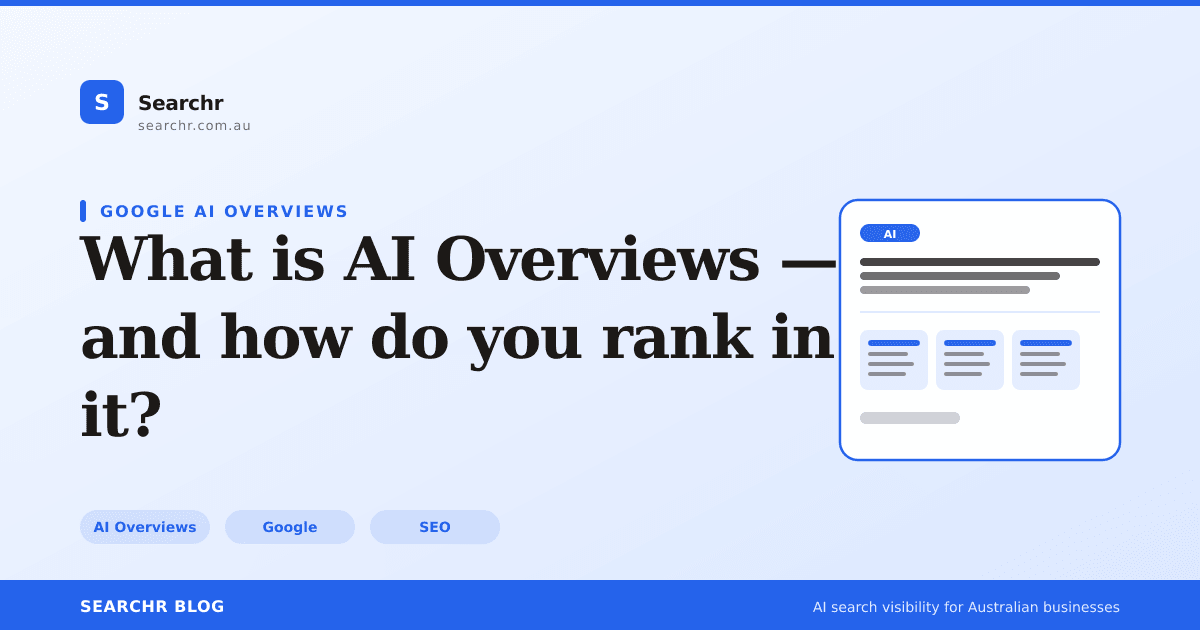
If you've Googled anything in the last 12 months, you've seen it: a short, AI-written answer at the top of the results page, complete with a few cited sources, an "AI Overview" label, and a small dropdown to expand the full response.
That block is AI Overviews — Google's AI-generated answer layer, now rolling out for the majority of informational queries in Australia. For local businesses, it's a quiet but seismic shift in how organic search actually works.
What AI Overviews actually is
AI Overviews uses Google's Gemini models to read the top results for a query, synthesise them into a single answer, and cite a handful of sources directly inside the response.
A typical Overview includes:
- A direct answer paragraph (sometimes two)
- Bulleted sub-points or steps
- Three to five linked source cards, each one a citation Google chose to include
- A "Show more" expansion if the topic is non-trivial
It appears for questions Google considers informational, comparative, or how-to in nature — "how much does landscaping cost in Sydney", "what's the best time to sell a house in Bondi", "do I need a permit to renovate my bathroom in NSW".
Why it matters more than you think
Three things happen the moment AI Overviews appears for a query you used to rank in:
- Organic click-through rates drop. Multiple Australian-market studies put the decline at 30–60% for queries where an Overview appears above the first organic result.
- The traffic that does click is more qualified. Users who scroll past the Overview have already been pre-screened — they wanted more than a summary.
- Being cited inside the Overview is now its own ranking goal. A citation in an Overview is a strong trust signal and a click source — and it's a slot most of your competitors don't even know exists.
Ranking #1 organic used to be the prize. Now the prize is being one of the three sources Google cites inside the AI answer that sits above the #1 result.
What gets cited inside an Overview
Google has been deliberately vague about how it picks Overview sources, but the pattern across thousands of audited results is clear. Cited pages tend to:
- Directly answer the question in the first 100 words — no preamble, no brand padding, just the answer.
- Use clean, semantic HTML (
h2,h3,ul,p) rather than divs full of marketing copy. - Carry strong topical authority — the rest of the site is about the same subject, not a generic catch-all.
- Have schema markup that matches the query intent:
FAQPage,HowTo,Article,LocalBusinesswhere relevant. - Be server-rendered. Overviews are built from the rendered HTML; client-rendered React apps with empty initial markup get skipped.
That's it. Most of it is content discipline, not magic.
The five-step playbook for being cited
Here's what we do for every Searchr page that needs to win Overview citations in its category:
1. Map the actual questions
Pull the People also ask questions, the long-tail queries from Search Console, and the questions Australian buyers ask AI assistants in your category. These are the prompts Overviews will be generated for.
2. Write a direct answer block
For each target question, write a 60–100 word answer that stands on its own, at the top of the relevant page, immediately after the h1. No "welcome to our blog where we explore…". Just the answer.
3. Mark it up
Wrap the question in a heading, the answer in a paragraph, and the whole block in FAQPage schema. Google's models prefer to cite content they can confidently identify as a Q&A.
4. Add geographic specificity
Local Overviews almost always cite local sources. "How much does landscaping cost in Sydney" will cite Sydney businesses, not generic national content. Name the suburbs, the postcodes, and the surrounding areas inside the answer itself.
5. Make sure it's server-rendered
View source on the published page. If the answer block isn't in the raw HTML, the Overview generation pipeline will never see it. This is the single most common reason perfectly good content doesn't get cited.
What not to do
- Don't bury the answer below 600 words of brand history. The model gives up before it gets there.
- Don't write for keyword density. Overviews reward clarity and confidence, not repetition.
- Don't rely on JavaScript-rendered FAQ accordions that only mount client-side. The schema is invisible to Google's pre-render pipeline in many cases.
- Don't game it with hidden text or repeated questions. Google's anti-spam systems on Overviews are aggressive and improving fast.
The honest summary
AI Overviews is reducing the value of being "ranked #1" and increasing the value of being "trusted enough to be quoted". For most Australian local businesses, the second is more achievable than the first — if the site is built right.
That's exactly what Searchr is built for: every page we ship is server-rendered, FAQ-marked, suburb-specific and structured to win Overview citations in its category. If you'd like us to audit your site for Overview-readiness, book a free demo and we'll show you exactly where you stand.